Application and Material Fit
January 8, 2026
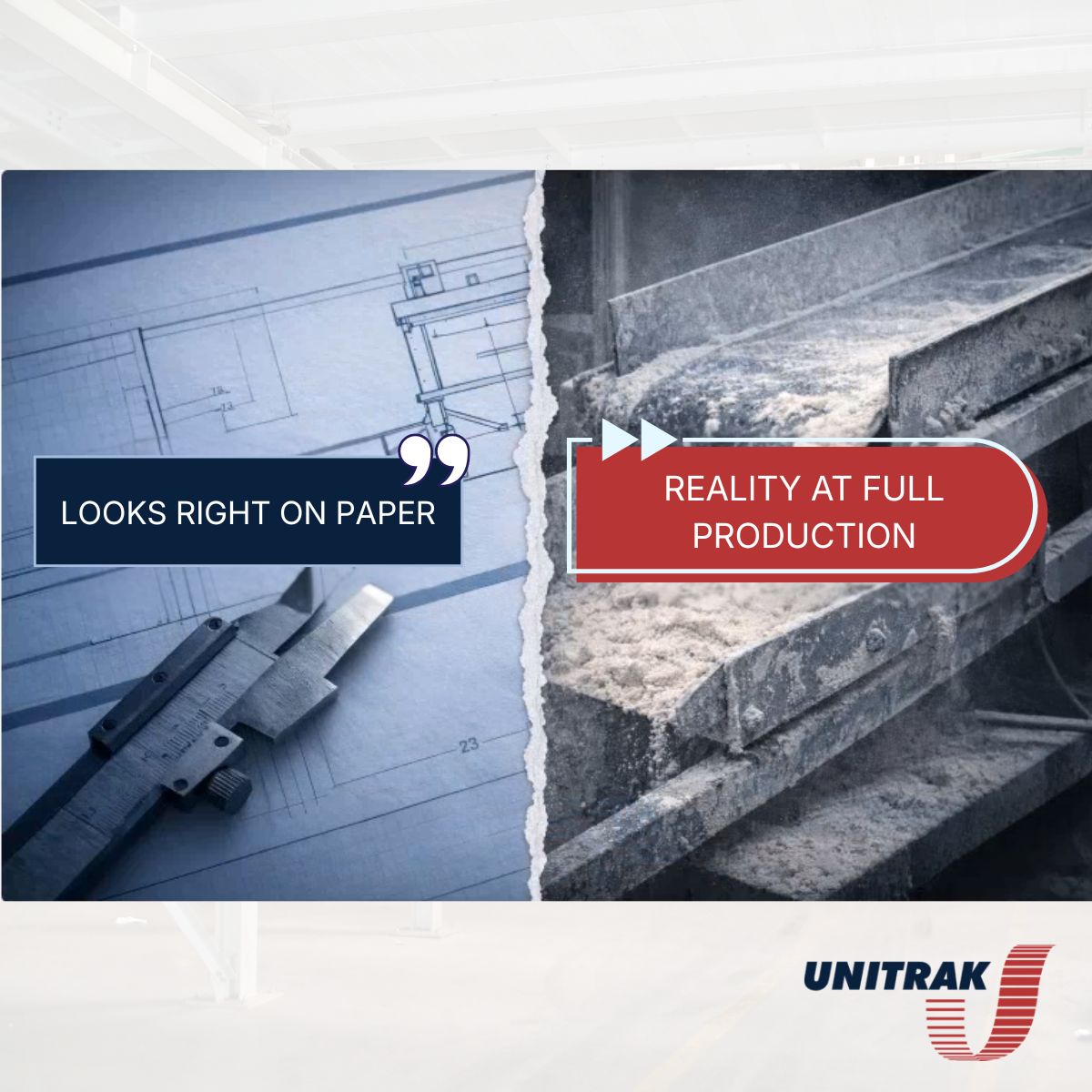
This article is Part 2 in UniTrak’s series on evaluating custom conveying equipment for bulk powders and dry solids. Part 1 explored why total cost of ownership often matters more than upfront price. This article focuses on application and material fit, the foundation of reliable conveying system performance.
You can design the most advanced conveying system in the world, but if it is not properly matched to the application and the material, performance problems are almost inevitable.
Across bulk solids industries, engineering guidance is consistent on this point: material behavior drives conveyor design. When application and material fit are wrong, everything else suffers. Throughput targets become unreliable. Wear accelerates. Dust increases. Downtime becomes routine.
For engineers, plant managers, and operations teams evaluating custom or customized conveying equipment, application fit is not a box to check early in the project. It is the foundation that determines whether the system will operate smoothly for years or require constant attention.
Bulk powders and dry solids do not behave predictably in the way liquids or discrete parts do. Their behavior shifts with particle size, moisture, temperature, bulk density, and how they are introduced into the system.
What makes this challenging is that small changes can have large consequences. A slight increase in moisture, a change in supplier, or a new formulation can completely alter how a material flows.
When application fit is not fully understood, common problems tend to appear quickly:
In our projects, we consistently see most chronic conveying issues traced back to assumptions made early in the design process. When application fit is treated like a checklist item rather than an engineering discipline, systems tend to operate “on the edge” instead of within a stable, predictable window.
Correct application fit aligns the conveyor with how the material actually behaves in real operating conditions. That alignment is what enables consistent flow, controlled wear, predictable maintenance, and stable production.
Every conveying project should start with a clear understanding of the material. These properties influence not just conveyor selection, but speed, geometry, materials of construction, and infeed design.
Bulk density affects drive sizing, structural loads, chain or belt selection, and bucket or flight capacity. More importantly, it often varies.
Seasonal changes, supplier differences, or upstream process conditions can all cause density swings. Designing only for average density is risky. Equipment needs to be sized for the upper range to avoid overloads and premature wear.
At UniTrak, we size drives, chains, and structural components based on upper-range density conditions rather than averages. This approach provides a margin of safety without forcing unnecessary oversizing elsewhere in the design.
Fine powders, granules, pellets, flakes, and irregular solids all behave differently.
Angular or irregular particles tend to interlock and resist flow. They pack differently in hoppers and transitions and are more likely to bridge. These materials typically benefit from slower conveying speeds and carefully designed inlets to maintain consistent flow.
This is why our engineers rarely rely on generic speed tables alone. With materials that tend to interlock or shear, we often slow conveying speeds, adjust bucket geometry, and refine infeed transitions to maintain flow without damaging product.
Flowability is one of the most underestimated factors in bulk solids handling.
A material that flows freely under one condition may become cohesive under another. Changes in humidity, temperature, or consolidation can turn a reliable system into a problem overnight.
Poorly flowing materials may require steeper hopper walls, controlled agitation, vibratory assistance, or precise feed control. Ignoring flow behavior almost always leads to intermittent operation and operator intervention.
Abrasive materials will wear equipment steadily and predictably. The question is whether the system is designed to manage that wear or suffer from it.
Abrasiveness drives decisions around liners, bucket style, chain or belt material, casing thickness, and conveying speed. Selecting the right wear materials early can significantly extend service life and reduce maintenance cost.
Some products must retain their shape or particle integrity. Fragile flakes, formed products, coated granules, and blended ingredients fall into this category.
These materials typically require low-speed conveying, gentle transitions, continuous bucket conveyors, and minimized transfer points. Excessive degradation not only affects product quality, it also increases dust and creates downstream handling issues.
For this reason, continuous bucket conveyors such as our TipTrak systems are selected in applications where preserving particle integrity matters. Their slow, controlled bucket path and minimal transfer points help protect fragile products from breakage and abrasion.
Moisture changes everything.
Hygroscopic powders may absorb moisture and shift from free-flowing to sticky. Even small increases in moisture can cause caking, buildup, or smearing.
Temperature adds another layer of complexity. Elevated temperatures can limit material choices for belts, seals, and liners while accelerating wear. Designs should always account for worst-case conditions, not just normal operation.
We routinely capture video, performance data, and wear observations during testing so engineering teams can make informed decisions before committing to a final design.
Many powders fall under combustible dust classifications. This affects enclosure design, grounding, venting strategies, and sealing requirements.
Dust is not just a compliance issue. It is often a symptom of product degradation, uncontrolled infeed, or poor containment. Addressing dust risk early improves both safety and reliability.
Food, pharmaceutical, and specialty chemical applications often demand hygienic or sanitary designs.
Smooth surfaces, minimal crevices, tool-less access, and validated cleaning processes all matter. Cleanability and changeover time directly affect operating efficiency and should be considered part of application fit, not an afterthought.
Material properties alone do not tell the whole story. How the material moves through the process is equally important.
Key questions include:
These answers guide conveyor geometry, drive selection, and infeed control strategy.
Throughput is often treated as a simple number. In practice, it is one of the most common sources of mismatch.
Over-sizing increases capital cost and energy use. Under-sizing creates bottlenecks that ripple through the entire process.
Buyers should clearly define average rates, peak rates, surge conditions, and tolerance for short-term overload. Effective designs match capacity to how the system actually runs, not just nameplate targets.
One of the strongest indicators of long-term success is early material testing.
At UniTrak, most custom projects begin with testing the customer’s actual material. This validates design assumptions and helps confirm bucket or flight selection, chain or belt type, liner materials, conveying speed, transition geometry, and dust containment strategy.
Testing identifies risks before installation and reduces surprises during commissioning. Vendors who skip this step or do not ask detailed material questions are transferring risk directly to the customer.
Like all continuous conveying technologies, TipTrak and PowderFlight systems rely on controlled, metered infeed to achieve optimal performance.
These conveyors require controlled, metered feeding. Flood loading or dumping large volumes of material into the conveyor can cause overloading, excessive dust, and product damage.
Common feed control methods include vibratory feeders, belt conveyors, and rotary valves.
Another frequent issue occurs when upstream equipment feeds from too great a height above the receiving buckets. Excessive drop height can lead to product breakage, bucket deflection, or increased dusting.
This often happens when a TipTrak is treated like a traditional centrifugal bucket elevator, where material is scooped from a boot section. Continuous bucket conveyors operate differently. They rely on controlled bucket filling, not bulk dumping.
These challenges are more common with new users or integrators unfamiliar with TipTrak operation and highlight the importance of early engineering alignment.
Many systems evolve after installation. New materials are introduced. Products change. Real-world behavior reveals details that were not obvious during design.
Features such as attachment points for future flow aids, provisions for clean-out trays, and flexible control strategies allow systems to adapt without major rework. Designing for these possibilities upfront reduces disruption later.
To assess application fit properly, buyers should ask vendors to:
A qualified vendor should be able to explain not just what equipment is proposed, but why it will work for your specific material and process.
When we engage on a project, these are the same questions we expect and welcome. A transparent engineering discussion early in the process helps protect the customer’s investment.
When application and material fit are addressed correctly, the benefits compound over time:
For custom or customized conveying equipment, application fit is not a secondary consideration. It is the framework that shapes every engineering decision and determines whether the system performs as intended for years to come.
Selecting the right conveying equipment starts with understanding your material, your process, and your long-term operating goals.
If you are evaluating custom or customized conveying solutions for powders or dry bulk solids, UniTrak’s application engineering team can help you assess material behavior, application fit, and technology options before costly decisions are made.
Talk to our experts to discuss your material, your process, and how to design a conveying system that delivers reliable performance from day one.
Coming up next in the series: How design decisions around wear, access, and maintainability shape long-term reliability and uptime. Check back soon or subscribe to our email newsletter to receive the series to your inbox along with other insights, updates and announcements from UniTrak.
299 Ward Street Port Hope, ON
L1A 4A4 Canada
Dinting Lane Ind. Est. Glossop
Derbyshire SK13 7NU UK

© UniTrak 2026. All rights reserved.


