Handling Corrosive Powders in Manufacturing: Risks, Design Considerations, and Conveying Best Practices
December 18, 2025
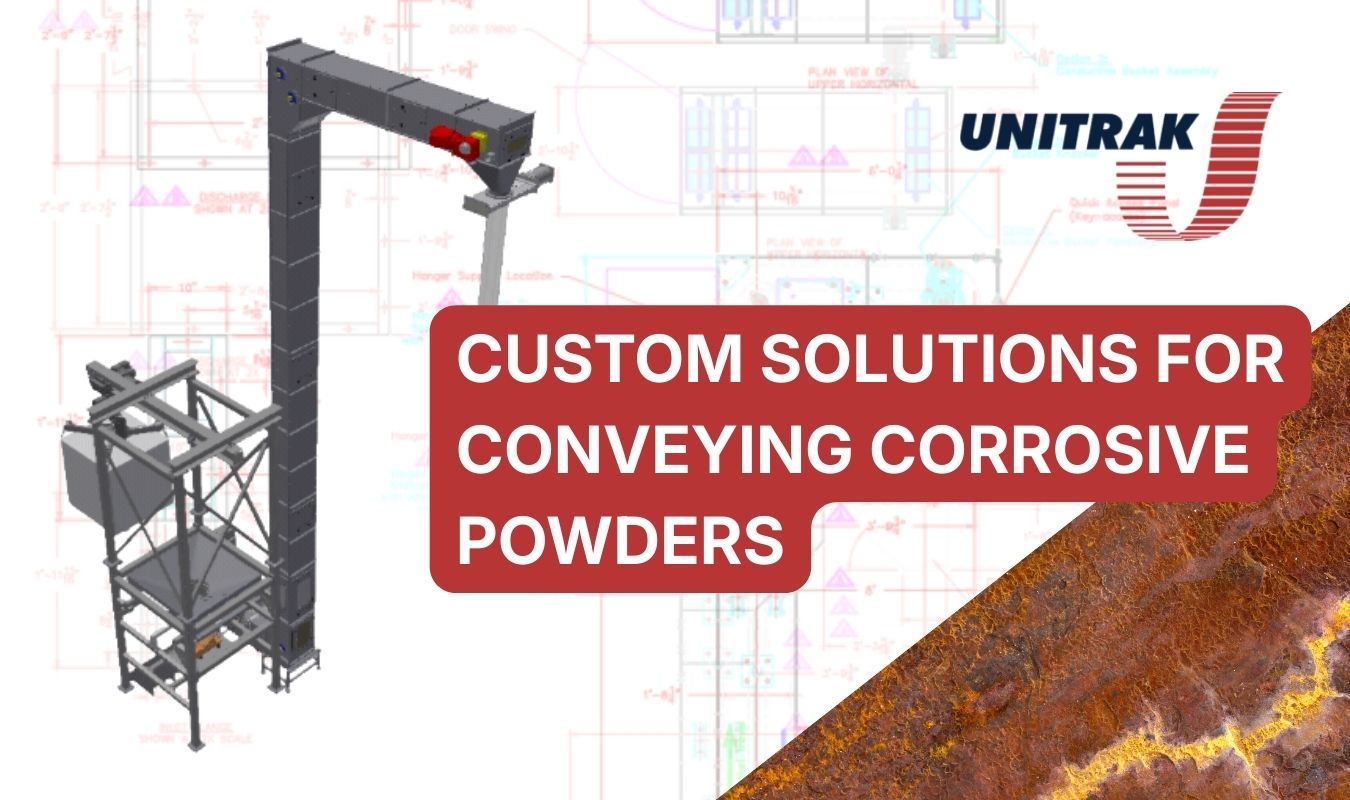
Corrosive powders are a quiet profit killer in processing plants.
They can attack carbon steel, pit stainless surfaces, degrade fasteners and seals, and create hidden failure points that surface as contamination, downtime, or safety incidents. Corrosion is not a niche issue either. The global cost of corrosion has been estimated at approximately US$2.5 trillion annually, or about 3.4% of global GDP.
If your facility handles corrosive powders or aggressive dry chemicals, even intermittently, conveying is one of the first places where risk, cost, and reliability intersect. This article covers:
Corrosive powders are materials that can damage equipment or harm workers through chemical attack, particularly when combined with humidity, heat, or contamination.
Common examples include:
Many powders are relatively stable when perfectly dry but become significantly more aggressive when moisture is introduced through ambient humidity, washdowns, condensation, or upstream process carryover.
Corrosive powders commonly drive uniform corrosion, localized pitting, crevice corrosion, and stress corrosion cracking. These failures are often non-linear. Equipment may appear to operate normally for extended periods before sudden leaks, cracks, or fastener failures occur.
Material selection plays a major role. For example, stainless steel 316 contains molybdenum, which improves resistance to chloride-induced pitting compared to 304 in many environments.
Once corrosion begins, the risk of metallic contamination increases. This can lead to off-spec product, rejected batches, and costly rework, especially in food, chemical, plastics, battery, and specialty material applications.
Airborne corrosive dust can irritate or burn eyes, skin, and respiratory tissue. Studies from NIOSH have shown that practical dust controls such as improved ventilation and better container interfaces can significantly reduce exposure during powder handling operations.
Some corrosive powders are also combustible or exist within processes that generate combustible dust conditions. In these cases, containment, grounding, and ignition control become essential parts of system design.
Airborne dust spreads corrosion throughout the plant, attacking motors, bearings, electrical systems, and structural steel. Effective designs prioritize:
Enclosed mechanical conveying systems, like our TipTrak Monocoque Bucket Conveyor can reduce dust migration compared to air-based transport methods, helping limit corrosion outside the conveyor itself.
Materials of construction must reflect actual operating conditions, including moisture, temperature, and chemical exposure. Stainless grade selection, coatings, and non-metallic components may all play a role, especially where powders are both corrosive and abrasive.
Moisture is one of the most aggressive corrosion accelerators. Designers should account for humidity swings, condensation, washdown procedures, and leaks that introduce moisture into otherwise dry zones.
Corrosive residues left in seams, corners, or dead zones can concentrate over time and accelerate localized attack. Smooth internal geometry, inspection access, and defined cleaning procedures are critical.
Every application is different, but mechanical conveying is frequently selected for corrosive powders because it helps reduce where corrosive material can travel, how it interacts with equipment, and how it is managed over time. In practice, mechanical conveying is often preferred because it supports:
In corrosion-driven reliability problems, reducing total exposure points often delivers the greatest long-term benefit.
For corrosive powder applications, TipTrak bucket conveyors are engineered to directly support the same objectives that drive mechanical conveying selection.
TipTrak operates at slow, controlled speeds and moves material in enclosed buckets rather than suspending it in high-velocity air. This reduces agitation of fine or reactive powders and helps limit dust generation at transfer points.
Fully enclosed, dust- and gas-tight casings further reduce the opportunity for airborne spread, helping contain corrosive material within the conveyor and away from surrounding plant equipment.
The fully enclosed design also minimizes interior ledges and edges where dust can accumulate.
Because TipTrak does not rely on air to move material, it can significantly reduce the need for extensive filtration, dust collection, or air handling infrastructure compared to air-based conveying approaches.
Conductive polymer bucket assemblies, full grounding, explosion-proof motors, and optional ATEX Zone 21 and 22 configurations support safe operation in hazardous or classified environments, without introducing additional airflow-related complexity.
TipTrak systems are designed to physically separate receiving, conveying, and discharge zones within a sealed enclosure. This segmentation limits where corrosive material is exposed, simplifies inspection and cleaning, and helps prevent corrosion from migrating into adjacent process areas.
Spillage-free, fully interlocking buckets and continuous joint strips keep material contained within the buckets and casing, reducing cleanup requirements and limiting corrosion outside the conveyor.
At the core of TipTrak is a rubber beltchain molded around pre-stretched stainless steel aircraft cables. Because the cables are pre-stretched before molding, the beltchain does not elongate in service and does not require retensioning.
UniTrak uses application-specific elastomers formulated to resist chemical attack, abrasion, and temperature extremes. Compared to traditional metal chains, rubber beltchains offer:
TipTrak severe service units feature rugged all-steel frames, available in stainless or carbon steel, and can be equipped with infeed controls to mitigate abusive or impact loading. UniTrak engineers work directly with customers to customize materials, bucket styles, beltchain compounds, enclosure sealing, purge configurations, and access features.
These solutions are often combined with TipTrak systems to create fully enclosed, corrosion-resistant material handling lines.
For manufacturers handling corrosive powders, success is not just about moving material. It is about controlling dust, limiting corrosion, protecting workers, and keeping equipment running predictably.
UniTrak mechanical conveying systems, including TipTrak, UniFlex, Powderflight and BagStander solutions, are selected when those outcomes matter more than simply moving volume.
From corrosive and abrasive powders to severe service environments, UniTrak engineers have solved thousands of challenging conveying applications. We can help you reduce risk, extend equipment life, and improve plant reliability. Speak with our team today to discuss your specific application.
299 Ward Street Port Hope, ON
L1A 4A4 Canada
Dinting Lane Ind. Est. Glossop
Derbyshire SK13 7NU UK

© UniTrak 2026. All rights reserved.


