When Repairs Become Routine: Is It Time to Replace Your Conveyor?
July 9, 2026
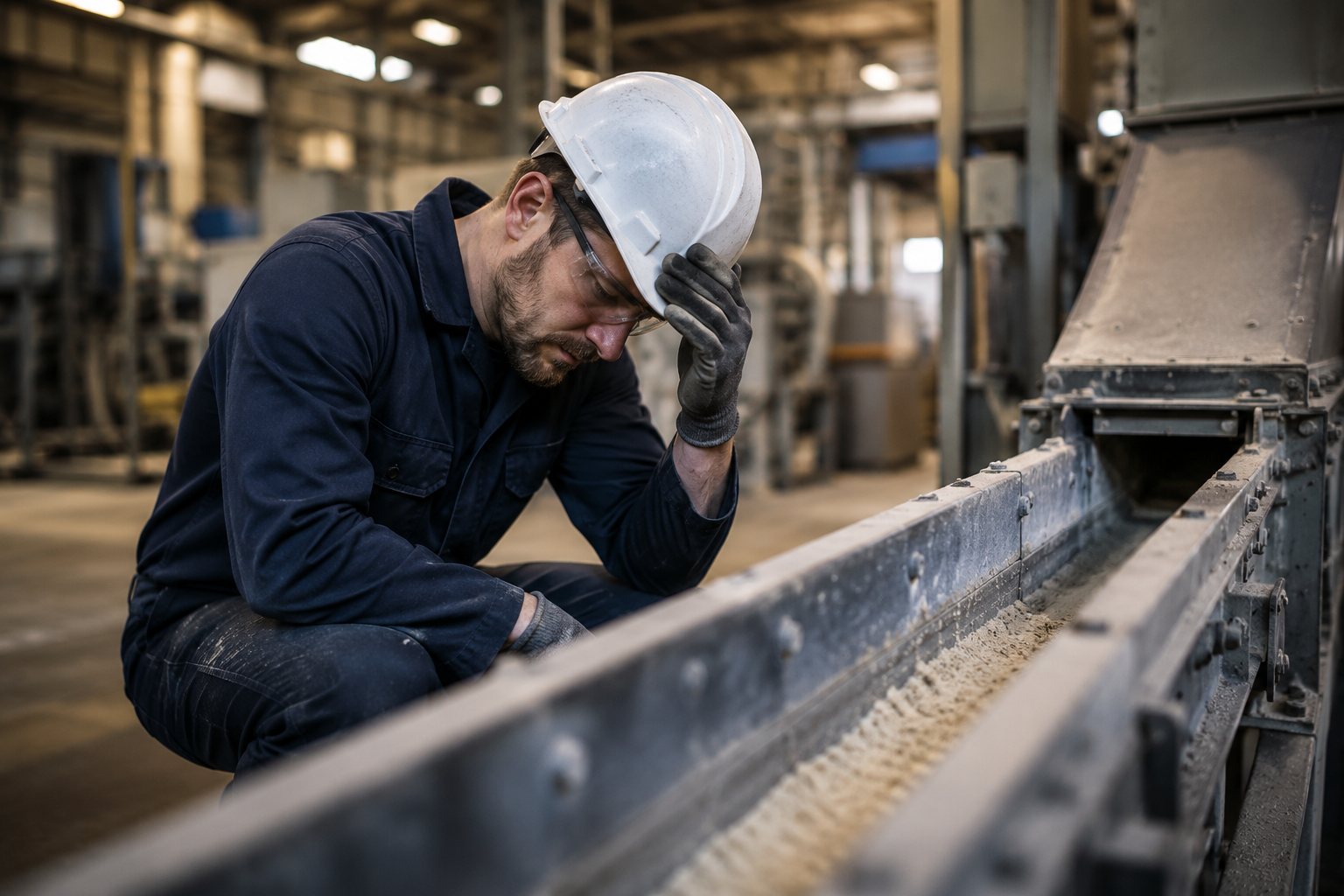
It's 2:30 on a Thursday afternoon.
Production has stopped. Again.
Maintenance is replacing another worn component. Operators are waiting. Product is piling up upstream, and everyone is asking the same question:
"Why does this keep happening?"
Many manufacturers assume the conveyor is simply getting old. Sometimes that's true.
But just as often, frequent repairs are a sign of something deeper. The material has changed. The process has evolved. Production demands have increased. The conveying method that worked years ago may no longer be the right fit today.
Before investing in another repair, it's worth asking a different question.
Is this conveyor still the right fit for my application?
Every conveying system requires maintenance. Bearings wear. Components eventually need replacement.
What shouldn't become routine is constant troubleshooting.
If your maintenance team is repeatedly addressing the same issues, replacing the same components, or scheduling repairs more often than planned, those maintenance costs may be pointing to a larger problem.
The conveyor may not be failing because it's poorly built. It may be operating in an application it was never designed to handle.
Difficult materials such as dusty powders, sticky products, abrasive minerals, fragile food ingredients, or blended formulations place very different demands on conveying equipment. When the conveying method doesn't match how the material behaves, wear accelerates and reliability suffers.
Repair costs are easy to measure.
The cost of downtime is often much larger.
Every unexpected shutdown affects production schedules, labor utilization, customer commitments, and overall plant efficiency. In many facilities, the repair itself is only a small part of the total cost.
When breakdowns become expected instead of unexpected, it may be time to evaluate whether continuing to repair the system is the most economical decision.
One of the first questions we ask when reviewing an application is simple:
Has the material always behaved this way?
If product is breaking, creating excessive dust, separating during conveying, sticking inside the equipment, or spilling onto the floor, the material is often telling you something.
These issues are frequently accepted as normal operating conditions when they may actually indicate that the conveying method is no longer the right fit.
The best conveyor is not necessarily the newest one.
It is the one engineered to move your material in a way that protects product quality while supporting reliable production.
Manufacturing rarely stands still.
Production volumes increase. New products are introduced. Packaging changes. Recipes evolve. Food safety standards become more demanding. Throughput expectations grow.
A conveying system that performed well years ago may struggle under today's operating conditions.
Rather than continuing to adapt an aging system through repairs, it may be worth evaluating whether your process has outgrown the original conveying approach.
Somewhere in many plants, there's a broom leaning against the same conveyor because everyone knows that's where product ends up.
Over time, those small losses become easy to ignore.
Until someone adds them up.
Dust, spillage, product degradation, segregation, and contamination risks don't just create housekeeping challenges. They reduce yield, increase cleanup time, consume labor, and impact profitability.
When those problems become part of daily operations, repairing the conveyor may not address the real issue.
The right conveying solution starts with understanding how the material behaves throughout the process.
When evaluating whether to repair or replace a conveyor, consider the bigger picture.
Instead of asking:
"Can we repair it?"
Ask:
These questions often reveal that what appears to be a maintenance problem is actually an application problem.
At UniTrak, we don't begin by recommending equipment.
We begin by understanding the material.
Every bulk material behaves differently. Powders flow differently than pellets. Fragile food products require a different approach than abrasive minerals. Sticky materials create challenges that dry products do not.
That's why the right conveying solution isn't determined by the conveyor alone. It's determined by how the material moves through your entire process.
In many cases, improving reliability isn't about installing a newer conveyor. It's about selecting a conveying solution that has been engineered specifically for the application.
If recurring repairs, excessive dust, product degradation, or ongoing maintenance have become part of everyday production, it may be time to look beyond the repair itself.
Our team can review your material, your process, and the operational challenges you're experiencing to help determine whether your current conveying method is still the right fit.
Because the best solution doesn't start with a conveyor.
It starts with understanding the material.
299 Ward Street Port Hope, ON
L1A 4A4 Canada
Dinting Lane Ind. Est. Glossop
Derbyshire SK13 7NU UK

© UniTrak 2026. All rights reserved.


